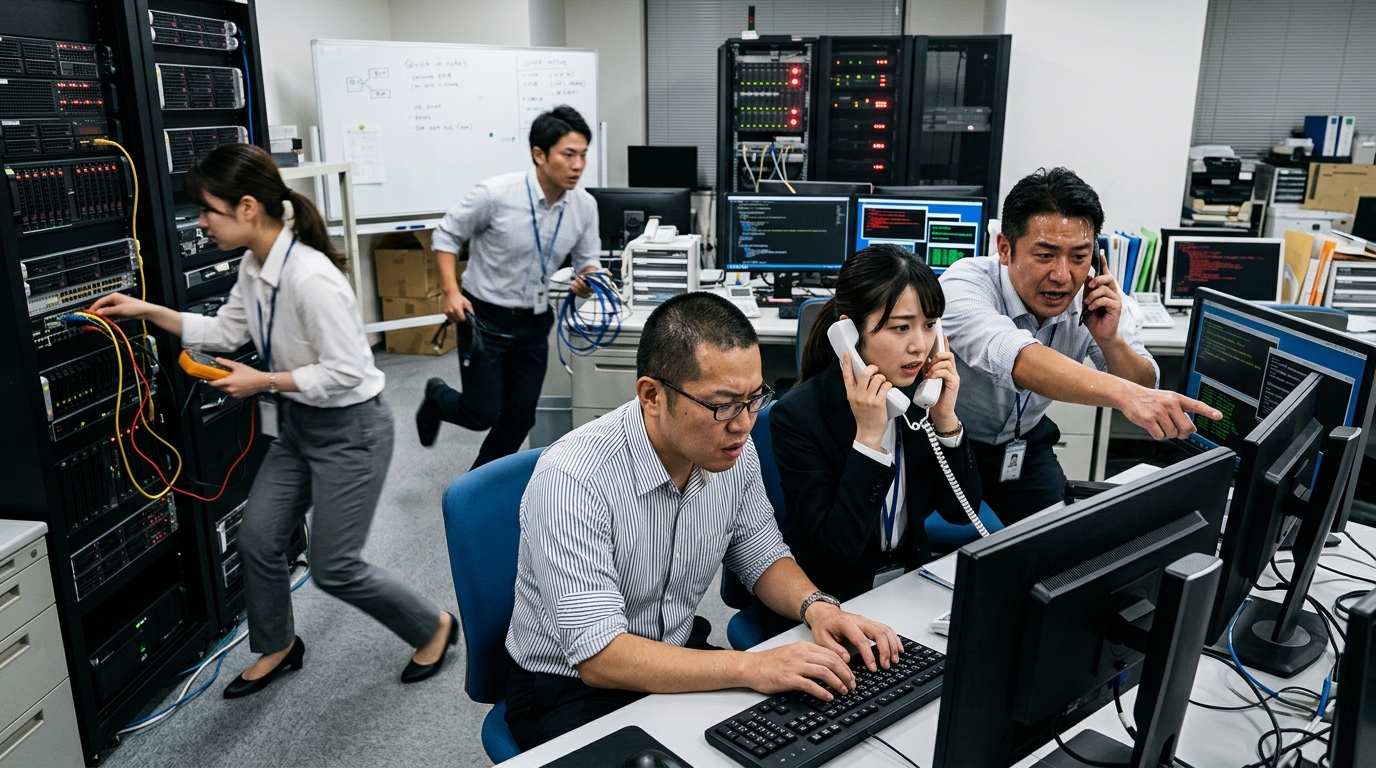
This is a fictional story from a certain company.
Monday morning.
Employees arrive at the office and turn on their computers as usual.
However...
I can't use email.
I can't even connect to the file server.
The business systems aren't working either.
Even after asking the IT department, they still don't know the cause.
The phones in the IT department are ringing non-stop.
I'm having trouble sending emails to my customers.
When will the HR system finally be usable?!
I can't connect to the shared cloud with other companies, so I can't work. When will it be fixed?
The restoration may take several hours.
It might take even longer.
So, what will your company do?
- Is it enough to just say, "Please restore it as soon as possible"?
- Decide what needs to be returned and by when.
- This company did not have that standard.
- First, let's think about a "job you can't stop doing."
- Consider using paper instead.
- And you also need to decide "who will make the decision."
- When a system stops working, it's not just the system that suffers.
- Security is not just about protecting the system.
Is it enough to just say, "Please restore it as soon as possible"?
If a system goes down, naturally, we want to restore it as quickly as possible.
But there's something I'd like to consider here.
What does "as soon as possible" mean in terms of hours?
Will it be sometime today?
Until tomorrow morning, perhaps?
Or would it be alright if it took a few days?
For example, some companies might be able to manage even if email is unavailable for half a day.
On the other hand, some companies experience significant impacts even if their order processing system is down for just two hours.
In other words, you don't need to think of all systems the same way.
Decide what needs to be returned and by when.
When considering business continuity,"To what extent will the restoration be carried out?",and"By when will it be restored?"That is one way of thinking.
Generally, these are organized using concepts such as target recovery level and target recovery time.
These words might sound difficult.
However, what we need to consider as a company is surprisingly simple.
"How long can this job be stopped before it becomes unacceptable?"
"And by when do we need to reopen?"
First, you need to decide this.
This company did not have that standard.
Let's say a system failure occurs at a certain company.
The staff are working desperately to restore service.
The president also listened with a worried expression.
"When will it be restored?"
The person in charge will answer.
"We will restore service as quickly as possible."
But actually, this company has"What should be prioritized, and by when will the restoration be completed?"There was no such standard.
Therefore, the person in charge tries to "put everything back as quickly as possible."
Of course, there's nothing wrong with that.
But is simply restoring the entire system to its original state really all that matters?
First, let's think about a "job you can't stop doing."
If it were me, I would include a list of systems along with the following:I will organize the details of the work.
For example, like this:
- How do you handle customer inquiries?
- How do I record the orders I received today?
- What items need to be shipped today?
- How do I contact my employees?
- Who makes important business decisions?
and,
"This is the one job I can't quit."
Let's consider this.
You don't need to try to maintain the same level of quality for every job.
Find the truly important tasks for the company and start thinking from there.
I think that's the first step.
Consider using paper instead.
Having said all this,
"Creating such a system seems like it would be very difficult."
You might think so.
But you don't need to create a large-scale system from the start.
for example,
- If the system stops working, record the order on paper.
- Keep emergency contact information on paper as well.
- Make it possible to access the minimum necessary information through a method other than the system.
This is another method.
What's important isn't creating a magnificent system.
"Even if the system is unusable, we can at least continue working up to this point."
This is a situation to keep in mind.
And you also need to decide "who will make the decision."
There's one more important thing.
When the system stopped,
"Who decides whether to wait for the restoration to be completed?"
"Who will stop operations?"
"Who will explain this to the customers?"
If things aren't decided beforehand, it becomes difficult for employees to take action.
that's why,
It's important to decide not only "what to do," but also "who will make the decisions."
This, too, is an important preparation to protect the company.
When a system stops working, it's not just the system that suffers.
Now that we've considered all of this, there's one more thing that's been bothering me.
"What do you need to continue doing that job?"
Is it just the system?
Who uses that system?
What information do you need?
Who makes the decision?
Who can do it instead?
for example,
"Only Mr./Ms. XX understands this job."
What if that were the case?
This isn't just a problem when the system stops working.
The fact that a company is dependent on specific individuals can itself be a risk to its downfall.
Security is not just about protecting the system.
When we talk about security measures, the conversation tends to revolve around "how to protect the system."
Of course, that's important.
But what a company truly wants to protect is probably not the system itself.
The people who work there, and the work they continue to do.
Therefore, when considering security, I believe it's important to first consider "the company's work."
What if the company's systems all shut down tomorrow morning?
In your company,
"What should you continue doing, by when, and how?"
Why not start by considering just one job?
And even if you realize that you hadn't thought about it that way before, that's not a bad thing.
You can start preparing for the company's needs as soon as you realize what needs to be done.
Next time, we'll start with something a little more familiar.
Is it really okay to say, "We have backups, so we're fine"?